
The Brains Behind Every Smart Device
Every intelligent edge product — from a vehicle ECU to an energy meter — thinks because of its model.
At Gettobyte Technologies, we design, train, and deploy optimized AI models that bring perception, prediction, and
decision-making directly into your embedded hardware.
Fast, efficient, and secure — that’s Edge AI done right.
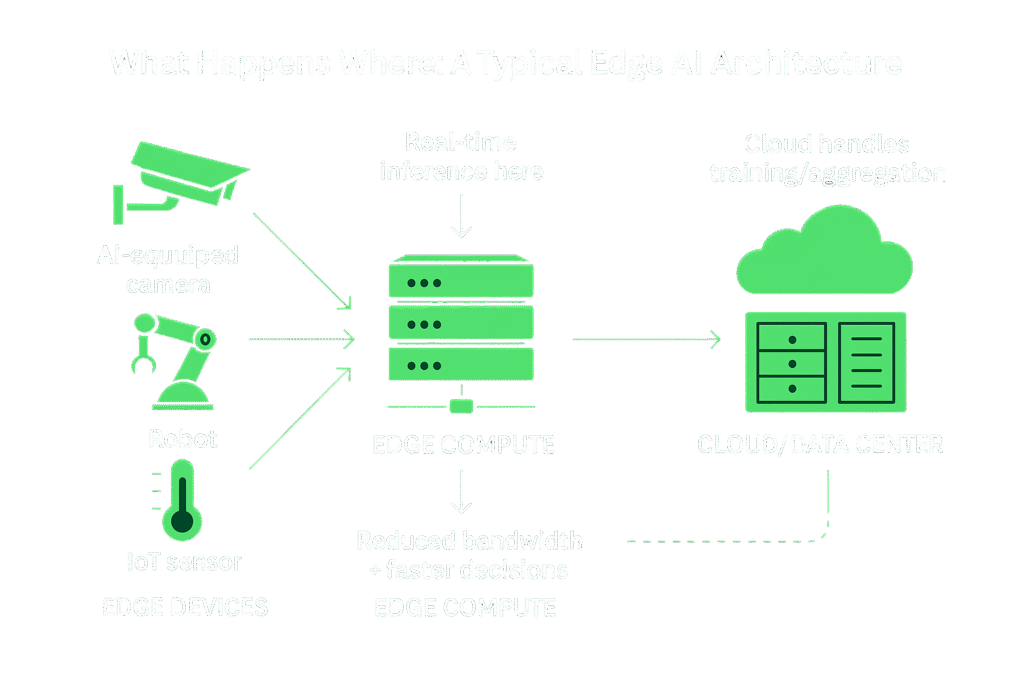
How AI Thinks at the Edge
Cloud AI is built for scale.
Edge AI is built for speed and autonomy.
Instead of sending gigabytes of data to remote servers, we embed trained AI models inside MCUs, MPUs, and NPUs —
allowing them to analyze sensor data, make decisions, and act instantly.
This means
Latency
in milliseconds, not seconds.
No dependency
on cloud connectivity.
Full data
privacy and security.
Lower bandwidth
and power consumption.
Core Edge AI Model Categories
Every Edge AI solution starts with choosing the right kind of model. We specialize in six families of AI models,
each solving a unique real-world problem.
Classification Models
Identify events, patterns, or objects within signals or images.
Used for fault diagnosis, gesture recognition, load classification, and occupancy detection.
Examples
SVM, Random Forest, 1D-CNN, TinyMLP
Edge Hardware
STM32H7, ESP32-S3, i.MX93
Optimization
Fixed-point FFT + quantized MLP
Detection & Localization Models
Locate multiple objects or events in space or time.
Used for ADAS, visual inspection, tamper detection, and safety zones.
Examples
YOLO-Nano, MobileNet-SSD, EfficientDet-Lite
Edge Hardware
Jetson Orin, TI TDA4, NXP i.MX93
Optimization
Pruned CNNs with TensorRT or TIDL engines
Anomaly Detection Models
Detect when something behaves abnormally — even without a defined fault label.
Used for motor vibration analysis, CAN bus security, and power tamper alerts.
Examples
Autoencoder, One-Class SVM, Isolation Forest
Edge Hardware
S32K3, STM32, Infineon Traveo II
Optimization
Sliding-window inference and feature embeddings
Forecasting & Predictive Models
Predict future trends from historical data. Used for load forecasting, battery state-of-health, and HVAC optimization.
Examples
ARIMA, LSTM, GRU, Temporal CNN
Edge Hardware
STM32, i.MX93, NXP S32G
Optimization
Quantized RNNs with time-window buffers
Sensor Fusion Models
Combine data from multiple sensors for better accuracy and context. Used in ADAS, smart HVAC, and industrial safety.
Examples
Kalman Filter, Particle Filter, CNN-LSTM Fusion
Edge Hardware
TI TDA4, NXP i.MX93, Jetson Nano
Optimization
Feature-level fusion and low-overhead synchronization
Optimization & Control Models
Adapt system behavior in real time for efficiency and stability. Used for HVAC setpoint control, irrigation scheduling,
robotics, and EV powertrain efficiency.
Examples
Reinforcement Learning (Q-Learning), Model Predictive Control (MPC), Adaptive PID
Edge Hardware
MCUs or MPUs with FreeRTOS/Zephyr
Optimization
Quantized policy networks executed per cycle
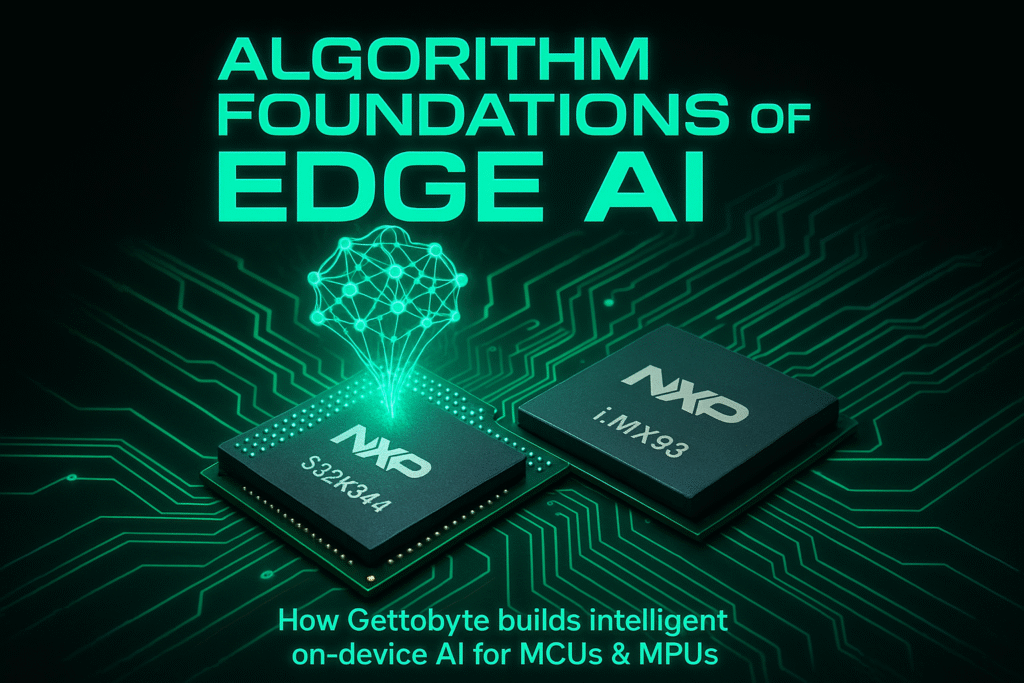
Algorithm Foundations
Edge AI is powered by a blend of machine-learning and signal-processing foundations.
At Gettobyte, we combine the best of both:
For Visually Understand
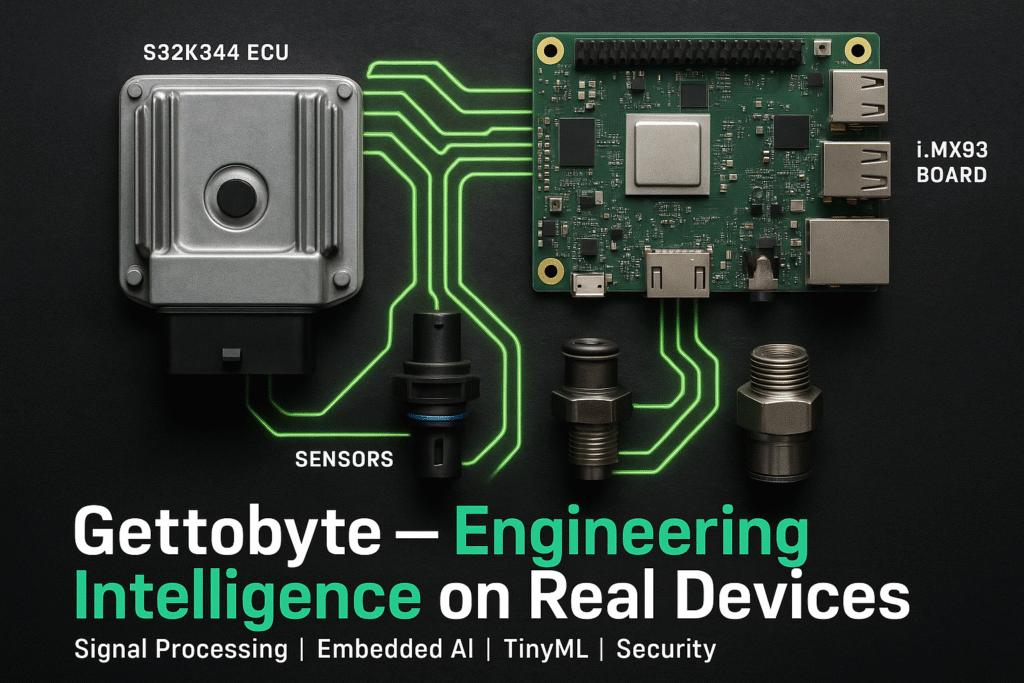
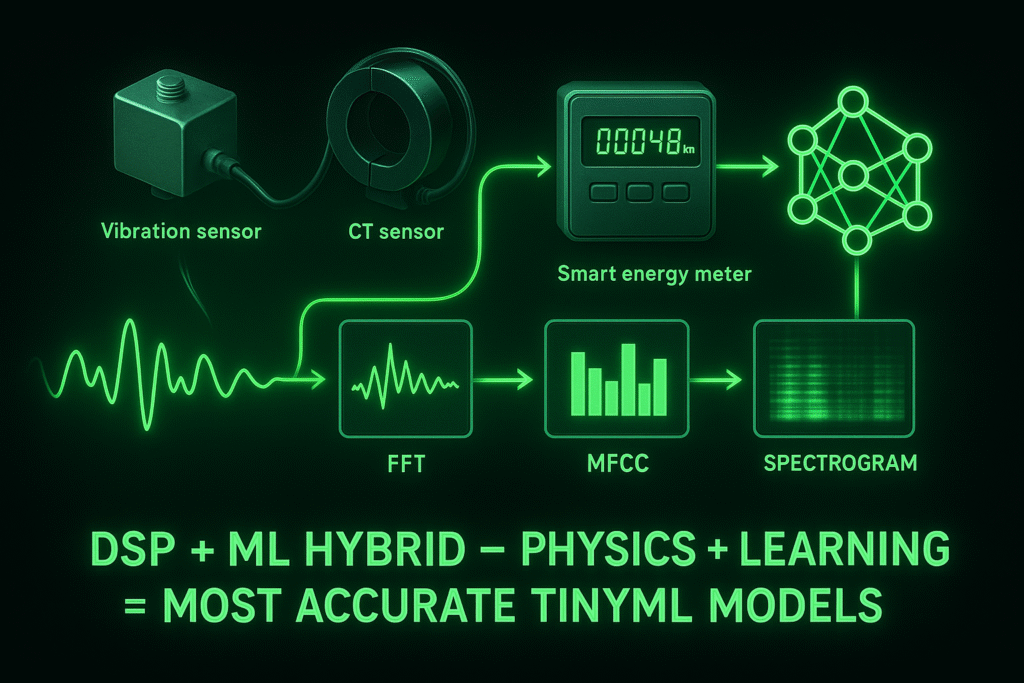


DSP + ML Hybrid
Feature engineering (FFT, MFCC) + light ML model Combines physics and learning for robust TinyML
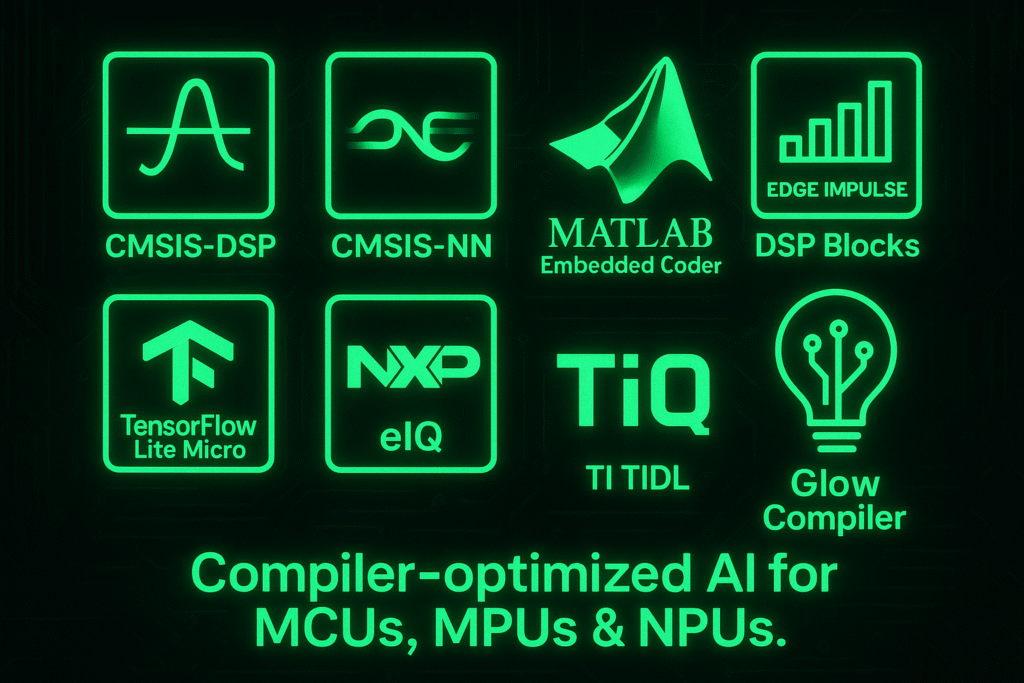
Toolchains We Use:
CMSIS-DSP, CMSIS-NN, Edge Impulse DSP blocks, MATLAB Embedded Coder, TensorFlow Lite Micro,
NXP eIQ, TI TIDL, Glow.
Embedded Optimization
Running AI on microcontrollers demands engineering precision.
Our team performs hardware-aware optimization for every model we deploy:
Quantization:
INT8/INT16 models for efficient inference
Pruning:
Remove redundant weights and layers
Memory Tiling:
Re-use activation buffers to fit in SRAM
Zero-Copy DMA Pipelines:
Sensor → Preprocess → Inference → Output
Power-Aware Scheduling:
Inference triggered only on events
Secure Inference:
Model and weights encrypted in HSM or TrustZone
The result
AI that runs in real time, within microcontroller limits, without sacrificing accuracy or security
Model-to-Industry Mapping

Our Approach to Model Engineering
Each project ends with a complete model card summarizing accuracy, latency, memory, and energy metrics — ensuring
full transparency and reproducibility.
Understand the Signal
Analyze sensor physics and sampling dynamics.
Design the Model
Select architecture based on latency and memory targets.
Train and Quantize
Use real datasets to build hardware-aware weights.
Deploy and Profile
Measure accuracy, RAM/Flash usage, inference time.
Secure and Scale
Protect models with HSE and enable OTA updates.
Bring Intelligence to Your Hardware
Whether you need a TinyML classifier on an MCU or a vision detector on an NPU, Gettobyte builds AI models tailored for
your hardware, data, and product goals
Bring Intelligence to Your Hardware
Whether you need a TinyML classifier on an MCU or a vision detector on an NPU, Gettobyte builds AI models tailored for
your hardware, data, and product goals